
Vehicle Types That Demand Specialized Photography
June 4, 2026
Specialized vehicle photography is defined as the practice of applying custom lighting setups, purpose-built equipment, and environment-specific workflows to capture vehicles whose physical complexity, reflective surfaces, or marketing demands exceed what standard automotive photography can deliver. Not every vehicle can be shot the same way. Luxury sports cars, commercial fleet trucks, heavy construction equipment, aircraft, and emergency vehicles each present distinct photographic challenges that require a photographer to rethink every variable from lens choice to location logistics. The types of vehicles requiring specialized photography span far more categories than most photographers realize, and understanding each one is the difference between imagery that sells and imagery that sits.
1. Luxury and high-end cars
Luxury vehicles are the most demanding subjects in high-end car photography because their value is communicated almost entirely through visual precision. A Rolls-Royce Ghost or a Lamborghini Huracán carries a price tag that buyers justify partly through the quality of the imagery they see before ever sitting in the driver’s seat. Every scratch in the clearcoat, every imperfect reflection in the hood, and every poorly lit interior shot signals to a buyer that the vehicle is not worth the ask.
The core challenge is reflection control. Metallic and pearlescent paint finishes act like mirrors, picking up every overhead light, boom arm, and camera rig in the room. Patented LED lighting domes with curved, non-reflective walls solve this by distributing light uniformly across every surface, eliminating the hotspots that plague standard studio setups. This matters because OEM-compliant imagery for dealerships and collectors requires zero distracting reflections.
Twilight and golden-hour shoots add emotional weight to luxury vehicle photo shoots. The combination of ambient sky color and controlled artificial fill light creates depth that a midday parking lot shot cannot replicate. Staged environments, whether a private estate driveway or a curated urban backdrop, reinforce brand identity and justify premium pricing in catalog and editorial contexts.
- Diffused LED dome lighting for metallic and matte finishes
- Controlled studio environments for reflection management
- Twilight and golden-hour location shoots for emotional appeal
- Interior macro photography for stitching, leather grain, and instrument detail
- Brand-consistent backdrop selection aligned with manufacturer guidelines
Pro Tip: When choosing between a controlled studio and an on-location shoot for a luxury vehicle, use the studio for paint and interior detail work, then move on-location for lifestyle and environmental context shots. The two approaches are complementary, not interchangeable.
2. Commercial vehicles and fleet trucks
Commercial vehicle photography operates on a completely different logic than luxury car work. The goal is not to make a single vehicle look aspirational. The goal is to make a fleet of 50 branded vans look operationally credible, professionally managed, and visually consistent across every marketing channel a logistics company uses.
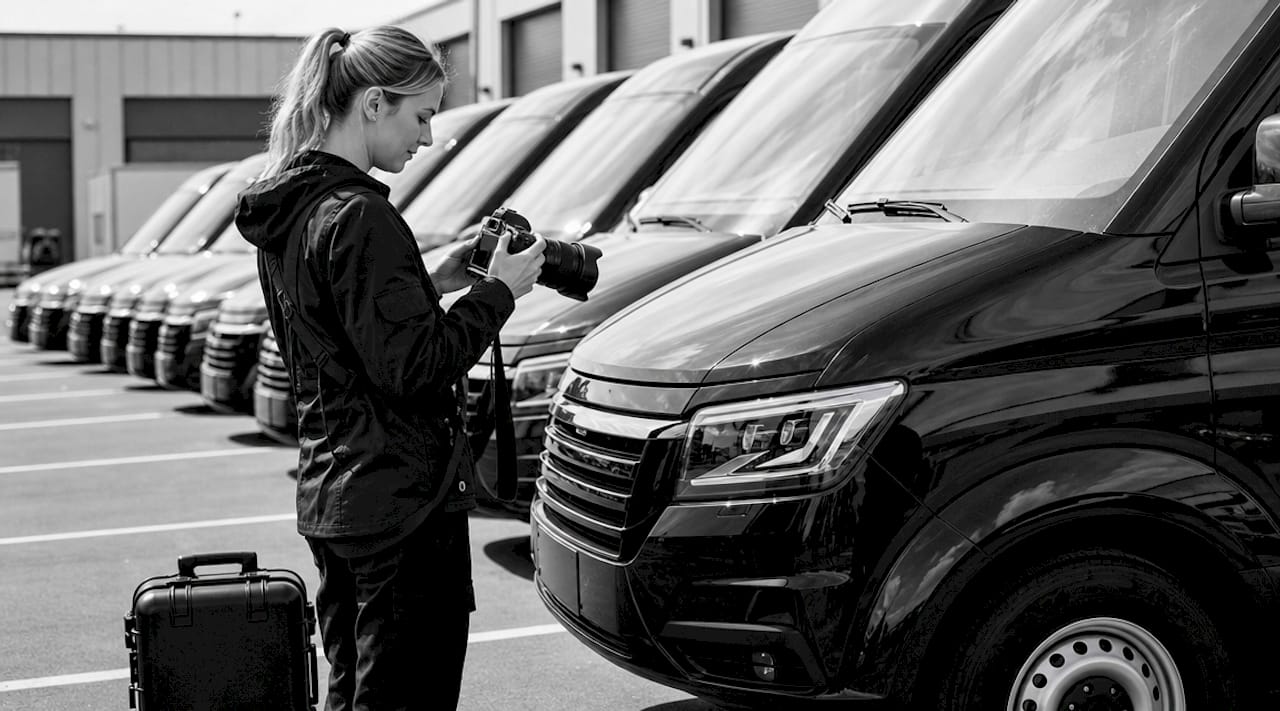
The first challenge is scale. Photographing a single truck is manageable. Photographing a 30-vehicle fleet with consistent lighting, consistent angles, and consistent color grading across a full day of shooting requires a production workflow that most photographers never build until they are standing in a depot at 6 a.m. wondering why the light is wrong on half the vehicles. Drone and aerial photography solve part of this problem by capturing fleet formations and depot scale in a single frame that ground-level shooting cannot achieve.
Including drivers and operations staff in fleet imagery is one of the most overlooked techniques in commercial vehicle photography. Human elements transform a photograph of a truck into a story about a company’s workforce, safety culture, and operational reliability. This matters directly for ESG and sustainability reporting, where corporate clients need imagery that communicates values, not just assets.
Branded livery photography adds another layer of complexity. Fleet wraps and vehicle graphics must be photographed in conditions that render color accurately and show decal detail without distortion. Overcast natural light or large diffusion panels work better than direct sun, which creates glare across vinyl surfaces and washes out color accuracy.
3. Heavy equipment and industrial vehicles
Heavy construction equipment, mining machinery, and agricultural vehicles present logistical problems that make traditional photography impractical in most situations. A 300-ton haul truck operating at a mine site cannot be stopped, cleaned, and repositioned for a photo shoot without significant operational disruption and cost. Even when access is granted, the environment is dusty, poorly lit, and rarely photogenic.
3D photorealistic CGI rendering built from CAD files solves these problems directly. A manufacturer can deliver a complete set of marketing assets, including cutaway views showing internal mechanical systems and images of the machine operating in realistic site environments, without a single on-site shoot. CGI also enables custom configurations to be visualized for tender documents before the machine is even built.
| Approach | Time required | Flexibility | Best use case |
|---|---|---|---|
| On-site photography | Several weeks | Low, dependent on site access | Operational context, documentary |
| Studio photography | Days | Moderate, limited by machine size | Product catalogs, dealer materials |
| 3D CGI rendering | Days | High, unlimited configurations | Tenders, catalogs, cutaway views |
The time comparison is significant. CGI rendering delivers assets in days versus the several weeks required for coordinating and executing on-site shoots for heavy machinery. For manufacturers working on product launch timelines, that difference is the deciding factor.
4. Aviation and aerospace vehicles
Aircraft photography is among the most operationally constrained categories in specialized vehicle photography. A photographer working on an airport ramp is operating inside an active safety zone with fueling operations, ground crew movements, and air traffic control windows that dictate exactly when and where a camera can be positioned. Understanding airport operations is not optional background knowledge. It is a prerequisite for getting the shoot approved and executed safely.
The photographic challenges are equally demanding. Aircraft exteriors are almost entirely reflective aluminum, composite panels, and polished nacelles. Managing reflections on a curved fuselage requires the same discipline as luxury car photography but at a scale that makes studio solutions impossible. Natural light management, particularly during the narrow window of twilight, becomes the primary tool.
Here is a practical workflow for aviation shoots:
- Coordinate with the FBO or flight operations manager at least two weeks before the shoot date to secure ramp access and identify safety constraints.
- Schedule the primary exterior shoot during the 20 to 30 minutes of civil twilight, when ambient sky light balances with artificial fill to eliminate harsh shadows on the fuselage.
- Use a wide-angle lens at f/8 to f/11 for full aircraft exterior shots, keeping the entire plane in focus without distortion at the wingtips.
- Transition to interior photography immediately after the exterior session, using portable LED panels to control cabin lighting without overheating the space.
- Capture lifestyle and environmental context shots, including crew boarding, ground crew activity, and terminal backgrounds, to support brand storytelling for charter and private aviation clients.
Lighting control and reflection management are the most critical factors separating professional aviation imagery from amateur attempts. A single poorly managed reflection across a cockpit windshield can make an otherwise excellent photograph unusable.
5. Emergency and specialty transport vehicles
Emergency vehicles, including ambulances, fire apparatus, and police vehicles, require photography approaches that balance technical precision with operational sensitivity. These vehicles are rarely available for extended shoots because they are in active service. A fire department may grant access to a new ladder truck for two hours on a weekday morning. That window must be used efficiently.
The photographic priorities for emergency vehicles differ from luxury or commercial work:
- Capturing safety markings, reflective striping, and emergency lighting in a way that reads clearly in both print and digital formats
- Documenting specialized equipment compartments and operational features for procurement and public communications
- Shooting in environments that communicate the vehicle’s operational context, such as a fire station bay or a hospital loading dock
- Managing the challenge of highly reflective emergency lighting bars and chrome fixtures without losing detail in surrounding surfaces
Specialty transport vehicles, including armored cash carriers, mobile command units, and oversized load haulers, carry complex decal systems and custom equipment that must be documented with the same precision as a product catalog shoot. Protecting vehicle graphics before and during a shoot matters here because any peeling or lifting on a decal will be visible in high-resolution imagery and undermine the professionalism of the final asset.
6. Automated studio photography for dealership inventory
Dealership inventory photography sits at the intersection of volume and quality, and automated studio solutions have changed how this category operates. Automated vehicle photo studios like 360Booth reduce full vehicle photo set production, including HDR images and 360-degree spins, to under 7 minutes compared to the 15 to 30 minutes required by traditional methods. That speed difference compounds across a dealership moving hundreds of units per month.
The technical foundation of these studios is the combination of patented curved wall systems and diffused LED lighting domes that deliver uniform reflection control across every paint color and finish type. This matters because a white sedan and a black sports car present completely different reflection challenges, and a studio that handles one well often fails on the other. Purpose-built systems eliminate that inconsistency.
Undercarriage photography has also advanced significantly. Specialized undercarriage apparatuses using telescoping supports with mounted cameras replace the manual process of positioning a photographer under a vehicle, improving both image consistency and safety. For certified pre-owned programs and online auction platforms, undercarriage documentation is now a standard deliverable, not an optional add-on.
7. Performance and motorsport vehicles
Rolling shots are the signature technique in motorsport and performance vehicle photography, and they are technically unforgiving. Only about 10% of frames captured during a rolling shot session are usable, which means a photographer must shoot in rapid burst mode and generate hundreds of frames to secure a handful of publication-ready images. This ratio demands both technical preparation and a clear pre-shoot plan for speed, distance, and camera-to-subject angle.
Performance vehicles also require photography that communicates motion even in static shots. Techniques like panning at slow shutter speeds to blur the background while keeping the vehicle sharp, or positioning the car on a track or canyon road to imply speed through environmental context, are standard practice in this category. The vehicle’s aerodynamic features, brake cooling ducts, and wide-body kits must be captured from angles that make their function visually obvious to an enthusiast audience.
Key takeaways
Specialized vehicle photography is defined by the specific technical, logistical, and marketing demands of each vehicle category, and no single approach works across all types.
| Point | Details |
|---|---|
| Luxury vehicles need reflection control | Patented LED dome studios and curved walls eliminate hotspots on metallic and matte finishes. |
| Commercial fleets require human context | Including drivers and staff in fleet imagery supports ESG narratives and corporate storytelling. |
| Heavy equipment benefits from CGI | 3D rendering delivers marketing assets in days versus weeks and enables cutaway views impossible with cameras. |
| Aviation shoots demand operational knowledge | Ramp access, twilight timing, and safety coordination are prerequisites, not optional preparation. |
| Automated studios transform inventory volume | Systems like 360Booth cut full vehicle photo set production to under 7 minutes per vehicle. |
What 35 years behind the lens taught me about vehicle specialization
Most photographers approach a new vehicle type by asking what gear they need. After 35 years and more than 550 magazine covers, I ask a different question first: what does this vehicle need to communicate, and what is physically preventing me from capturing that?
A Bugatti Chiron and a Kenworth T680 are both vehicles. They share almost nothing else in terms of photographic approach. The Bugatti needs a controlled environment, precise reflection management, and lighting that makes the paint look like it is lit from within. The Kenworth needs a working environment, a driver in the cab, and light that makes the truck look like it can haul 80,000 pounds without breaking a sweat. Applying the same techniques to both produces mediocre results for each.
The trend I find most significant right now is the integration of CGI into categories where traditional photography was always assumed to be the answer. Heavy equipment manufacturers are producing entire product catalogs without a single on-site shoot, and the results are indistinguishable from photography to most viewers. That is not a threat to photographers who specialize in vehicles with genuine photographic complexity. It is a signal to focus your expertise where cameras still outperform algorithms: luxury finishes, aviation twilight work, and the human storytelling layer of commercial fleet imagery.
My practical advice is this: master light control first, then master the operational context of whatever vehicle category you want to own. The photographers who struggle with aviation work are not struggling because of their cameras. They are struggling because they do not understand how an FBO operates. The same principle applies to every specialized category in this field.
— Ray Baldino
See what specialized expertise looks like in practice
Baldinoautomotive brings over 35 years of professional experience to every vehicle category covered in this article. Whether you are a dealership needing OEM-compliant luxury car imagery, a private collector with an exotic vehicle that deserves proper documentation, or a commercial client building a fleet photography program, the studio has the equipment, the workflow, and the technical depth to deliver.
Ray Baldino’s work has appeared on more than 550 magazine covers, and the studio holds certification from the Professional Photographers of America. That level of credentialed experience translates directly into imagery that performs in the market. Explore professional automotive photography services built specifically for vehicles that demand more than a standard shoot, and see why dealerships, collectors, and commercial clients trust Baldinoautomotive with their most demanding projects.
FAQ
What vehicles need specialized photography most?
Luxury cars, aircraft, heavy equipment, commercial fleets, and emergency vehicles all require specialized photography because their surfaces, scale, or operational context exceed what standard automotive techniques can handle. Each category demands custom lighting, equipment, or workflow solutions.
How does CGI compare to photography for heavy equipment?
3D CGI rendering delivers marketing assets in days versus several weeks for on-site heavy equipment photography, and it enables cutaway views and custom configurations that cameras cannot capture. For product catalogs and tender documents, CGI is now the preferred approach for most major manufacturers.
Why is twilight photography important for aviation and luxury vehicles?
Twilight provides a narrow window where ambient sky light and controlled artificial fill balance naturally, eliminating harsh shadows and creating depth that midday or studio-only lighting cannot replicate. For aircraft exteriors and luxury car location shoots, this window is often the most valuable 20 to 30 minutes of the entire production day.
What makes fleet photography different from single-vehicle shoots?
Fleet photography requires consistent lighting, angles, and color grading across dozens of vehicles shot in a single session, plus the inclusion of human elements like drivers to support corporate storytelling. A single-vehicle shoot optimizes for one subject. A fleet shoot optimizes for a system.
How fast can automated studios photograph dealership inventory?
Automated vehicle photo studios like 360Booth complete a full photo set, including HDR images and 360-degree spins, in under 7 minutes per vehicle compared to 15 to 30 minutes with traditional methods. That speed makes high-volume dealership inventory photography economically viable at scale.

