
Automotive Commercial Photography: What Businesses Need to Know
June 4, 2026
Automotive commercial photography is the specialized practice of creating vehicle images built for marketing campaigns, advertising materials, and brand communications. Unlike a hobbyist shooting at a car meet or an editorial photographer documenting a road trip, commercial automotive work operates from a client brief, a defined visual objective, and a production budget that reflects the stakes involved. Cameras like Phase One medium format systems, tilt-shift lenses, and controlled lighting rigs are standard tools on a professional commercial shoot. The goal is never just a sharp photo of a car. The goal is an image that sells, persuades, or builds brand equity.
What is automotive commercial photography and why does it matter?
Automotive commercial photography is defined by high production values including studio lighting, controlled environments, and advanced post-production setups designed specifically for client campaigns. This separates it from editorial car photography, which prioritizes journalistic storytelling, and from personal enthusiast photography, which prioritizes the owner’s emotional connection to the vehicle.
The distinction matters because the purpose shapes every decision on set. A commercial shoot for a luxury dealership requires images that communicate aspiration, precision, and exclusivity. A personal portrait of the same car might prioritize nostalgia or raw power. The commercial photographer answers to a brand identity. The enthusiast answers only to personal taste.
Automotive brand photography, automotive advertising photography, and commissioned automotive portrait photography all fall under this commercial umbrella. Each serves a different deliverable: a national ad campaign, a dealership brochure, or a bespoke print for a private collector. What unites them is the requirement that the image perform a specific commercial function.
What techniques and equipment define professional automotive commercial shoots?
The technical demands of commercial vehicle photography are genuinely different from most other photography disciplines. Vehicles are large, curved, and almost entirely reflective. Every element in the environment shows up in the paint. That reality drives the entire equipment and technique strategy.
Key tools and methods used by professional commercial automotive photographers include:
- Tilt-shift lenses such as the Canon TS-E 24mm and Canon TS-E 90mm, which control scale and perspective distortion unique to large vehicle subjects. Standard lenses distort a car’s proportions at close range. Tilt-shift lenses correct that without requiring extreme shooting distances.
- Circular Polarizer (CPL) filters, which are critical for managing reflections across bodywork that covers roughly 90 percent of a vehicle’s surface. Without a CPL, paint reflections become uncontrollable in outdoor and mixed-light environments.
- High-resolution camera systems, including medium format bodies, which capture the fine detail of paint texture, chrome trim, and interior materials that commercial clients demand.
- Multi-layer post-production workflows that composite lighting passes, remove unwanted reflections, and refine color accuracy without stripping the image of its visual energy.
- Lighting architecture built around the vehicle’s body lines. Professional commercial photographers design light to trace the character lines pressed into a car’s body, creating depth and dimensionality that flat lighting destroys.
Pro Tip: On any commercial automotive shoot, spend more time controlling your environment than adjusting your camera settings. Environmental management is the single largest factor in image quality when shooting reflective vehicle surfaces.
How does commercial automotive photography differ from other types?
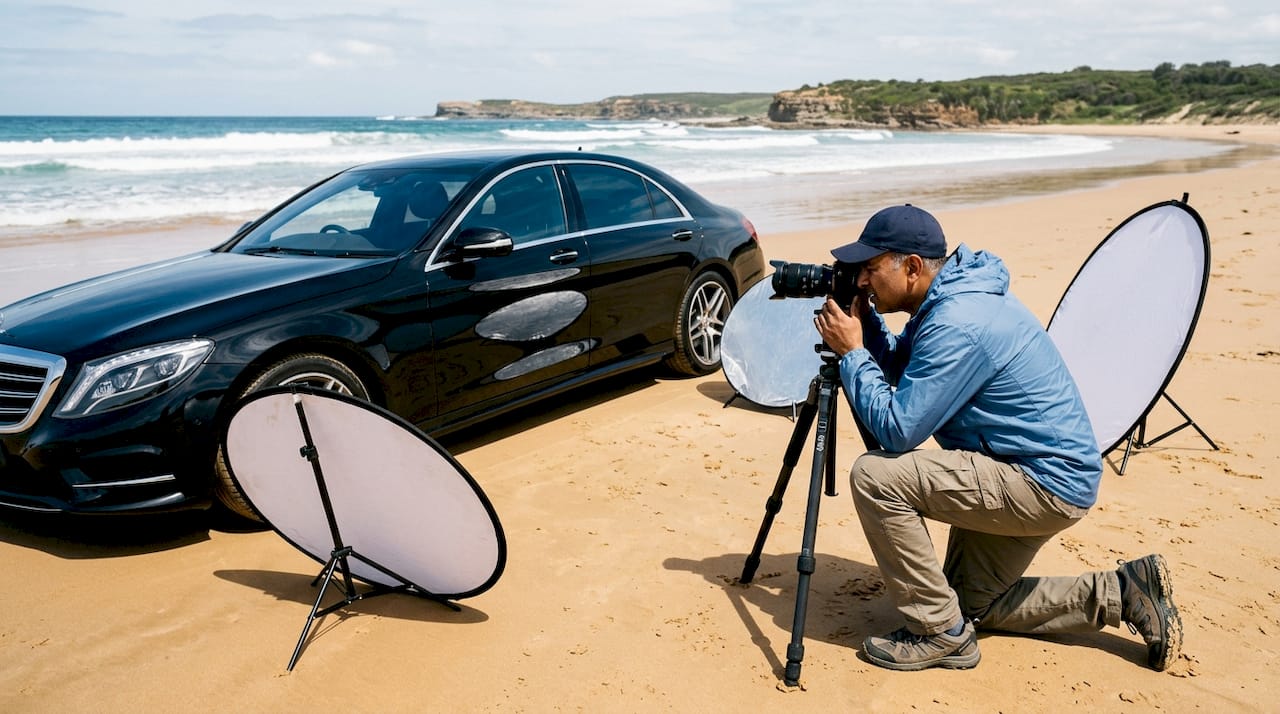
The clearest way to understand commercial automotive photography is to compare it directly with the two other major categories: editorial and enthusiast photography.
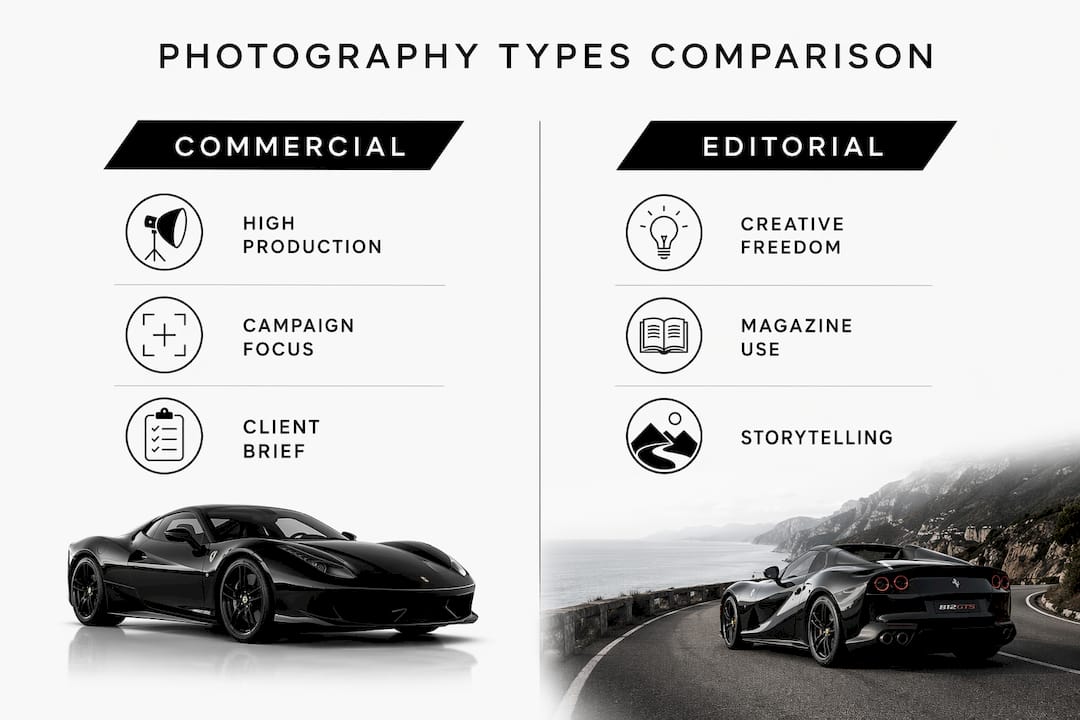
| Category | Primary purpose | Planning level | Production values | Output |
|---|---|---|---|---|
| Commercial | Brand campaigns, advertising, sales | High. Client brief, pre-production, location scouting | Studio lighting, controlled sets, post-production | Ads, brochures, digital campaigns |
| Editorial | Magazine features, journalism, reviews | Moderate. Story-driven, flexible | Natural light preferred, minimal retouching | Magazine spreads, online articles |
| Enthusiast | Personal expression, community sharing | Low. Spontaneous or casual | Consumer gear, minimal post-production | Social media, personal archives |
Commercial work carries the highest production requirements because the images carry financial consequences. A dealership running a regional ad campaign on a $200,000 vehicle cannot afford images that look like they were taken in a parking lot. Narrative-driven imagery that communicates brand authority and emotional connection is the standard expectation, not a premium add-on.
Automotive fine art photography and automotive photography as wall art occupy an interesting middle ground. These disciplines share commercial photography’s commitment to technical excellence and artistic intent, but the output serves a collector or gallery market rather than an advertising campaign. What artistic automotive photography means in practice is the pursuit of an image that stands alone as a visual object, independent of any product message.
What challenges do photographers face in automotive commercial photography?
Photographing vehicles for commercial use presents a specific set of problems that do not exist at the same scale in portrait, product, or landscape photography. The challenges are technical, logistical, and creative simultaneously.
The core technical challenge is reflection management. A car’s painted surface is essentially a curved mirror. Contextually appropriate environments represent approximately 60 percent of image effectiveness, which means the wrong location does not just look bad aesthetically. It actively degrades the image by introducing unwanted reflections that no amount of post-production can fully remove.
Additional challenges commercial automotive photographers navigate include:
- Balancing natural and artificial light without creating mixed-color-temperature zones that read as muddy or inconsistent on the vehicle’s paint.
- Perspective and scale distortion when shooting large vehicles at close range, which makes the car look toy-like or disproportionate without corrective lenses.
- Location scouting for contextual authenticity, particularly for electric vehicles, vintage cars, or performance vehicles where the wrong backdrop undermines the vehicle’s identity.
- Weather and time-of-day management for outdoor shoots, where golden hour light can be spectacular but lasts only minutes and cannot be rescheduled.
Pro Tip: Scout your location at the same time of day you plan to shoot. The light and reflective environment at noon are completely different from what you will find at 6 a.m., and the difference will show in the paint.
How does automotive commercial photography enhance branding and marketing?
The business case for professional automotive commercial photography is direct. Professional images produce a 20% increase in engagement and higher final bid prices compared to amateur or generic photos. That figure reflects something deeper than aesthetics. Professional image sets function as a psychological anchor, creating a perception of scarcity and value that generic stock photos cannot replicate.
“Technical perfection is the entry fee. The professional edge is in photography that communicates the car’s soul and cultural narrative, elevating the image beyond documentation.” — MotorFlair
For dealerships, private collectors, and automotive brands, this translates into measurable commercial outcomes. A luxury SUV photographed with controlled studio lighting, a contextually matched location, and a post-production workflow that preserves paint depth will consistently outperform the same vehicle shot in a dealer lot under fluorescent lights. The image communicates that the vehicle is worth the asking price before a single word of copy is read.
Automotive brand photography goes further by connecting the vehicle to a cultural identity. A restored 1967 Shelby GT500 photographed against a period-appropriate backdrop with research-informed styling choices tells a story that resonates with collectors and enthusiasts at an emotional level. That emotional resonance is what separates a sale from a missed opportunity.
Generic stock photography, by contrast, is a slow death for automotive branding. It signals to the viewer that the brand does not consider the vehicle worth a dedicated shoot. That signal is received, even if it is never consciously processed.
Professional tips for businesses commissioning automotive commercial work
Whether you are a dealership, a private collector, or an automotive brand preparing a campaign, the following practices will maximize the return on your photography investment.
- Research the vehicle’s history and cultural context before the shoot. Connecting a vehicle’s history and community to the imagery produces photographs that resonate emotionally rather than simply documenting the car’s appearance.
- Match the environment to the vehicle’s identity. A modern electric vehicle belongs in a clean, architectural setting. A vintage muscle car belongs somewhere with texture and history. The wrong location undermines the vehicle’s story regardless of how technically perfect the lighting is.
- Invest in post-production as a creative step, not just a cleanup task. Multi-layer retouching that refines reflections, corrects color, and enhances body line definition is what separates a commercial-grade image from a well-executed snapshot.
- Brief your photographer on the campaign objective, not just the vehicle. The best commercial automotive photography is deeply researched and tailored to the brand, vehicle niche, and intended audience. A photographer who understands the campaign goal will make better creative decisions on set.
- Avoid stock-style imagery for any vehicle you are actively selling or marketing. The moment a viewer recognizes a generic approach, the psychological anchor that professional photography creates is gone. Authenticity is not a stylistic preference. It is a commercial requirement.
Key takeaways
Automotive commercial photography produces measurable marketing results because it combines technical mastery, environmental control, and narrative-driven storytelling to create images that generic stock photography cannot replicate.
| Point | Details |
|---|---|
| Commercial photography is campaign-driven | It operates from a client brief and defined visual objective, not personal preference. |
| Environment controls image quality | Contextually appropriate locations represent approximately 60% of image effectiveness on reflective surfaces. |
| Professional images drive engagement | Professional photography produces a 20% increase in engagement and higher sale prices versus amateur images. |
| Storytelling separates good from great | Researching vehicle history and cultural context produces emotionally resonant images that sell. |
| Post-production is a creative tool | Multi-layer retouching refines reflections and body line definition to commercial-grade standards. |
Why I think most automotive photography misses the point entirely
After 35 years behind the camera and more than 550 magazine covers, I have watched the automotive photography industry make the same mistake on repeat. Photographers obsess over gear, lighting ratios, and lens choices while completely ignoring the one thing that makes an image worth looking at: the story the car carries.
Every vehicle has a cultural fingerprint. A Ferrari 250 GTO is not just a red car with a V12. It is a specific moment in motorsport history, a specific community of collectors, a specific set of emotional associations that a viewer either connects with or does not. When I approach a commercial shoot, the camera is the last thing I think about. The first thing I think about is what this car means and to whom.
The market is shifting in the right direction. Clients who once asked for “clean, white background shots” are now asking for imagery that tells a story. That shift reflects a broader understanding that visual storytelling drives brand loyalty in ways that product documentation never will. The photographers who will lead this industry over the next decade are not the ones with the best gear. They are the ones who do the research, understand the vehicle’s identity, and build an image around that truth.
Technical perfection is table stakes. Soul is the differentiator.
— Ray Baldino
Explore professional automotive commercial photography with Baldino Automotive
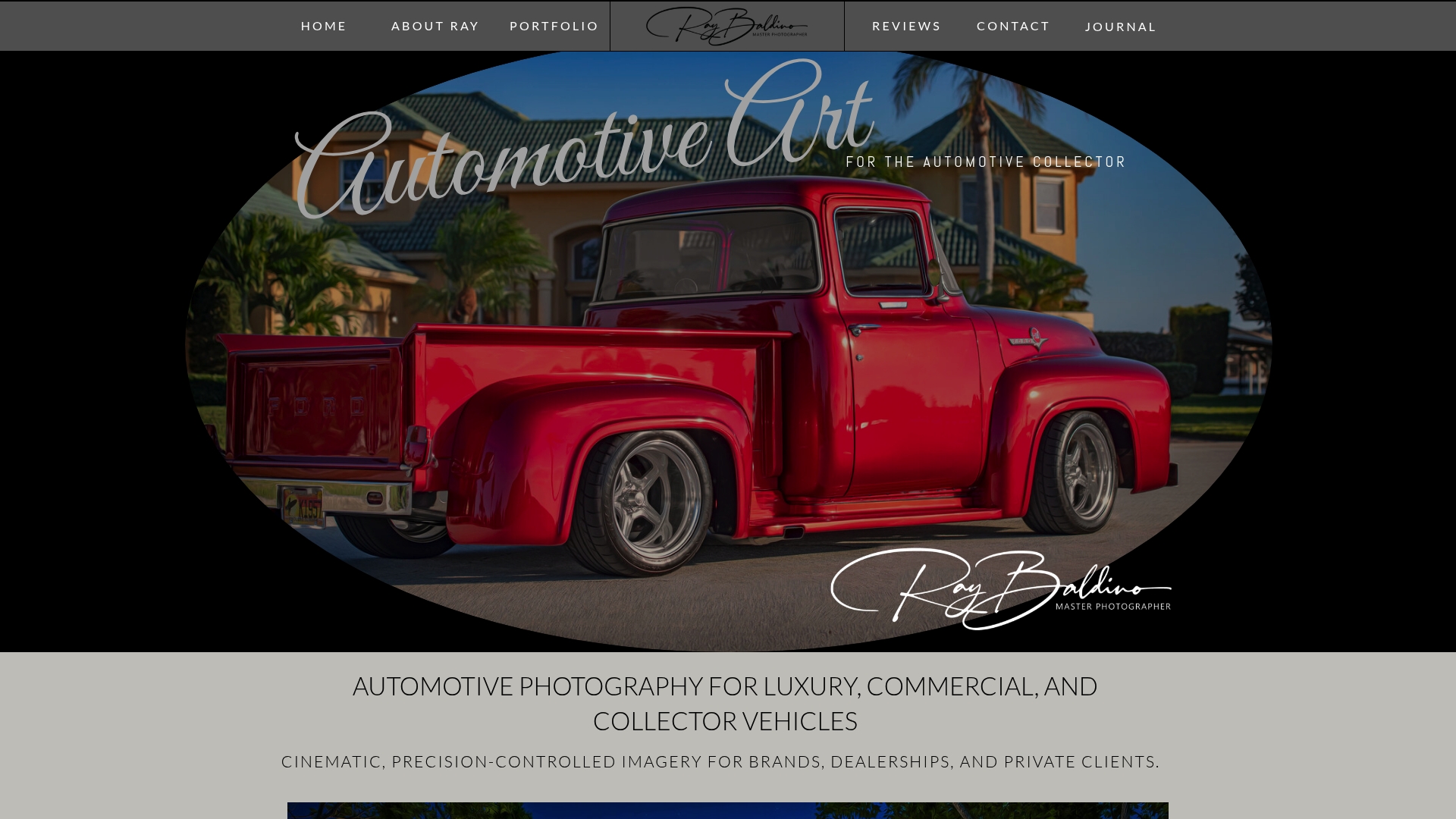
Baldino Automotive delivers high-end commercial vehicle photography for dealerships, private collectors, and automotive brands across Florida. Led by Ray Baldino, a Master Photographer certified by the Professional Photographers of America with over 35 years of experience, the studio brings the same discipline to every shoot: controlled lighting, location-matched environments, and post-production that preserves the vehicle’s visual identity. Whether you need a full campaign shoot for a luxury marque or a commissioned automotive portrait for a private collection, Baldino Automotive produces imagery that performs commercially. Explore the studio’s work and book a consultation at Baldino Automotive.
FAQ
What is automotive commercial photography?
Automotive commercial photography is the practice of creating vehicle images for marketing campaigns, advertising, and brand communications. It is defined by high production values, controlled environments, and campaign-focused planning that distinguishes it from editorial or personal car photography.
How does automotive brand photography differ from editorial car photography?
Automotive brand photography operates from a client brief and serves a specific commercial objective such as a dealership ad or product brochure. Editorial car photography prioritizes journalistic storytelling and typically uses natural light with minimal post-production.
What equipment is standard in professional automotive commercial photography?
Professional commercial automotive photographers use tilt-shift lenses such as the Canon TS-E 24mm and 90mm, CPL filters for reflection management, high-resolution camera systems, and multi-layer post-production workflows to achieve commercial-grade results.
What is automotive fine art photography?
Automotive fine art photography applies the technical standards of commercial vehicle photography to produce images intended as standalone art objects for collectors or galleries, rather than as advertising or marketing materials.
Does professional automotive photography actually improve sales results?
Professional automotive photography produces a 20% increase in engagement and higher final bid prices compared to amateur or generic images, because professional image sets create a psychological perception of value and scarcity that stock photography cannot replicate.

