
Inventory Photography for Dealerships: 2026 Guide
June 12, 2026
Inventory photography for car dealerships is the standardized process of capturing consistent, high-quality images and video of every vehicle on a lot to drive online engagement and sales. Known in the industry as dealership inventory photography or vehicle listing photography, this practice goes far beyond pointing a smartphone at a car. It involves specific shot lists, disciplined workflows, and AI-powered post-production tools that transform raw lot photos into compelling online listings. Services like those offered by Baldinoautomotive and operational platforms referenced by Redline Lot Services demonstrate how structured photography directly increases lead generation and shortens the time between acquisition and a live listing.
What is inventory photography at dealerships?
Inventory photography for dealerships is a repeatable, operational system. It is not a creative exercise. The goal is to produce a complete, consistent photo set for every vehicle so that online buyers can make confident decisions without visiting the lot. A vehicle without a professional photo set remains invisible to most buyers online, regardless of its condition or price. That invisibility directly costs the dealership leads and revenue.
The process covers every vehicle category on the lot, from certified pre-owned sedans to high-end performance vehicles. Each unit receives the same treatment: a defined number of angles, a clean background, and post-processed images ready for upload to the dealership management system (DMS) or customer relationship management (CRM) platform. The visual content standard in 2026 combines multiple still photos with video and 360-degree spins to answer buyer questions before the first phone call.
Consistency is the defining characteristic of effective dealership photography. Buyers browsing listings on platforms like Cars.com or AutoTrader form trust judgments within seconds. A clean, consistent background paired with a standardized shot sequence signals professionalism and builds brand credibility at scale.
What shot lists and equipment do dealerships use?
A standard shot list for dealership inventory photography covers 11–15 angles per vehicle. These angles address four categories: exterior, interior, detail shots, and the odometer. A standardized 11–15 angle shot list completed with a modern smartphone and AI post-production allows each vehicle to be photographed in 8–12 minutes. That speed matters when a dealership receives 20 or more trade-ins in a single week.
Exterior angles
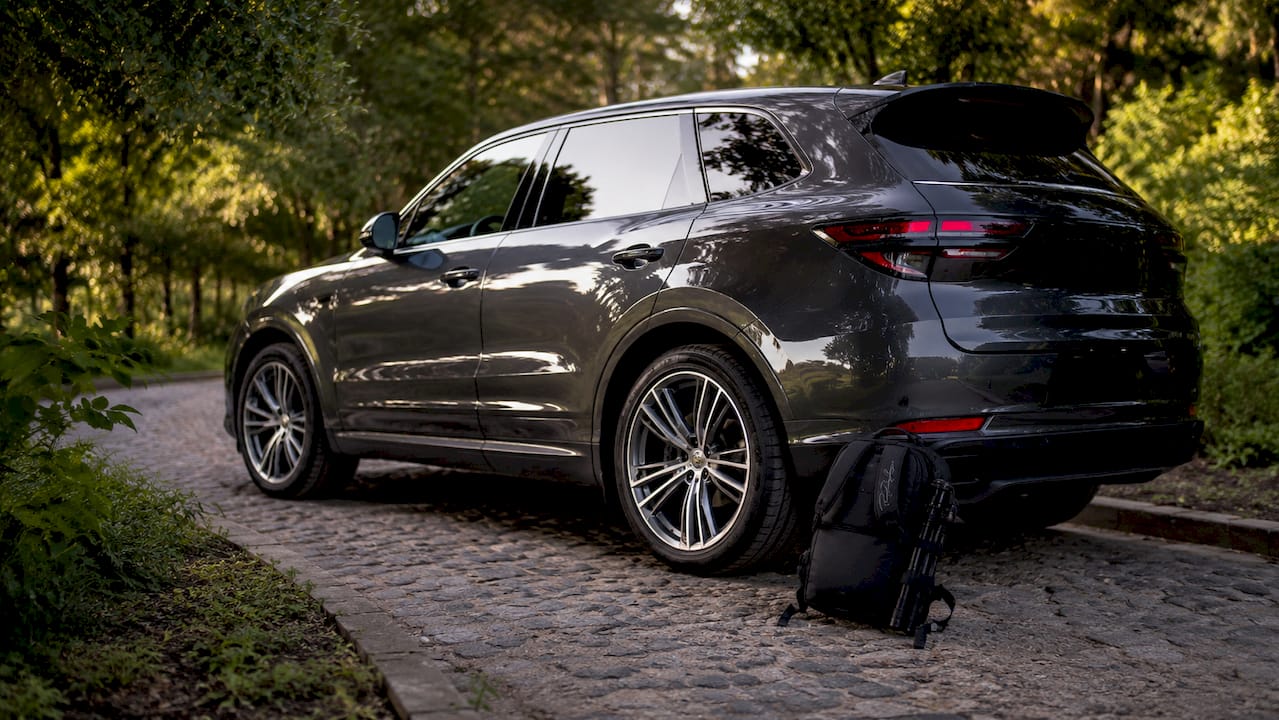
The exterior sequence typically includes the front three-quarter view, driver side profile, rear three-quarter view, passenger side profile, front grille, and rear badge or tailgate. These six shots establish the vehicle’s overall condition and visual appeal. Shooting in the same order every time reduces errors and speeds up post-production sorting.
Interior and detail shots
Interior shots cover the dashboard, front seats, rear seats, cargo area, and center console. Detail shots capture the odometer reading, VIN plate, tire condition, and any notable features like a sunroof or upgraded wheels. For luxury or performance vehicles, additional detail shots of the engine bay or branded interior trim add value to the listing.
Equipment choices
Modern smartphones, specifically the iPhone 13 and newer or the Samsung Galaxy S21 and newer, produce sufficient image quality for inventory photography. High-end DSLR cameras are not required for standard lot photography. What matters more is lighting consistency and shot discipline. Shooting during the same time of day and in the same location on the lot eliminates variables that slow down post-production.
| Equipment Type | Best Use Case | Cost Range |
|---|---|---|
| Modern Smartphone | Daily lot photography, AI workflow | Low |
| Mirrorless Camera | Premium listings, luxury vehicles | Medium to High |
| 360-Degree Camera | Spin photography for VDP enhancement | Medium |
| Drone | Aerial exterior shots, large inventory | Medium to High |
Pro Tip: Sequence your shot list by moving clockwise around the vehicle every time. This habit eliminates skipped angles and makes the post-production review faster because every image set follows the same visual order.
How does inventory photography impact sales metrics?
The business case for structured dealership photography is direct and measurable. Dealerships with an automated photography workflow see vehicles 40% more likely to generate leads and up to 675% more Vehicle Detail Page (VDP) traffic compared to listings using stock images. That gap between stock and real photos is not a minor preference difference. It reflects how buyers actually behave online.
Listings with professional photos receive up to 140% more views on major automotive marketplace sites compared to listings with dark or cluttered images. More views translate directly into more inquiries, more test drive appointments, and faster sales cycles.
“The ‘gold standard’ visual content in 2026 combines multiple photos with video and 360 spins to answer buyer questions upfront, reducing sales friction.” — Camera-Ready Vehicles: Visual Content Playbook
Time-to-market is another critical metric. Optimizing inventory photography processes reduces time-to-market by up to 82%, with many dealerships achieving live listings within 24–48 hours after reconditioning. Every day a vehicle sits off the market is a holding cost. Faster listings mean faster sales and lower carrying expenses.
| Metric | Impact of Structured Photography |
|---|---|
| Lead Generation | Up to 40% increase vs. stock images |
| VDP Traffic | Up to 675% increase vs. stock images |
| Listing Views | Up to 140% more on marketplace sites |
| Time-to-Market | Up to 82% reduction in listing delays |
Professional listings that meet the 12–18 photo standard, combined with a 360-degree spin and a 60–90 second video walkaround, consistently outperform minimal listings across every measurable buyer engagement metric.
What workflows and staff roles optimize dealership photography?
The most critical factor for successful inventory photography is a standardized operational workflow tied directly to the reconditioning process, not camera equipment. Dealerships that treat photography as an afterthought, something done when someone has time, consistently underperform on listing speed and lead volume.
A well-structured workflow assigns clear ownership. The three most common models are a dedicated in-house photographer, a trained lot porter who photographs vehicles as part of their daily duties, or a rotating staff assignment with a defined checklist. Each model works when the process is documented and enforced. The model fails when photography is treated as optional or secondary to other tasks.
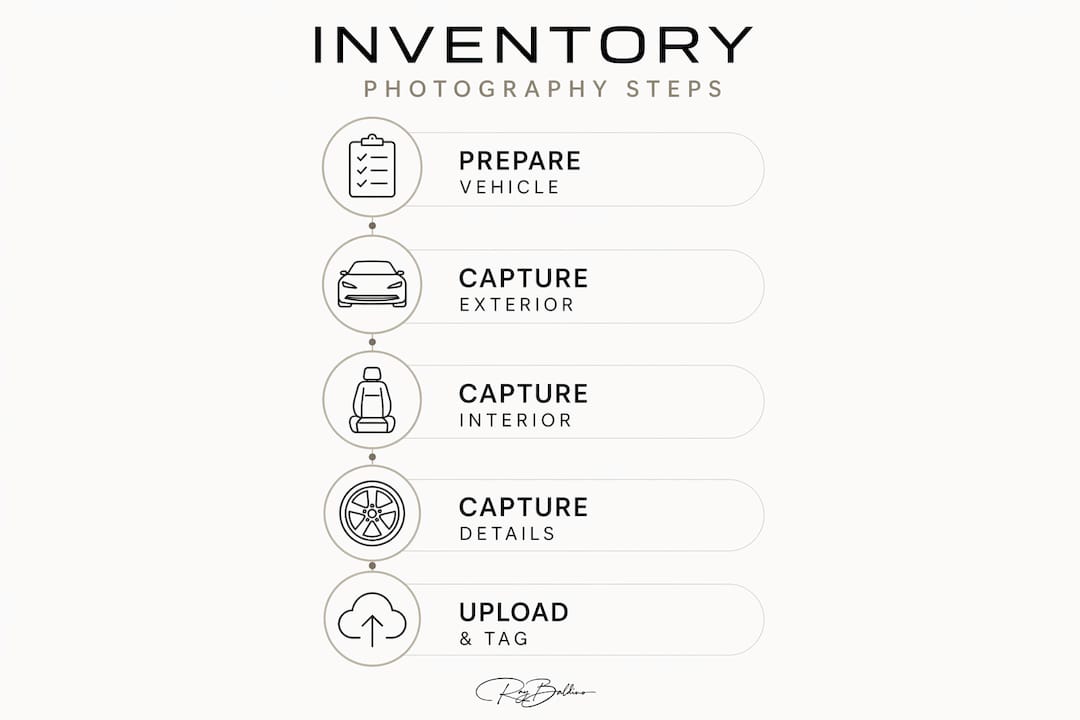
Here is a practical daily workflow sequence that high-performing dealerships use:
- Pull the reconditioning completion report each morning to identify vehicles ready for photography.
- Stage vehicles in the designated photography area or consistent lot location before 10 a.m. to use optimal natural light.
- Complete the exterior shot sequence for all vehicles before moving to interiors. Batching by category reduces repositioning time.
- Photograph interiors and detail shots as a second pass through the same vehicle group.
- Upload completed image sets to the DMS or CRM immediately after each session, not at the end of the day.
- Verify that every uploaded listing has the correct metadata, including year, make, model, trim, and mileage.
Daily photographic tasks with consistent shot lists and rapid uploading to DMS and CRM systems help dealerships list vehicles faster and generate leads earlier in the sales cycle. Batching and same-day uploads are the two habits that separate high-volume, high-performing lots from those with chronic listing delays.
Pro Tip: Assign one person to own the photography checklist each day. When everyone is responsible, no one is. A single point of accountability cuts missed vehicles and upload errors by a significant margin.
How is technology changing dealership inventory photography?
AI-driven tools have fundamentally changed what is possible for dealerships of every size. The most significant advancement is AI background replacement, which allows staff to shoot vehicles anywhere on the lot and then digitally swap the background to produce a clean, studio-quality result. AI background replacement eliminates the need for dedicated photo bays and enables consistent results even in poor weather conditions.
Beyond background replacement, modern AI post-production platforms handle several tasks automatically:
- Exposure correction: Balances uneven lighting caused by overcast skies or direct sunlight without manual editing.
- License plate blurring: Automatically obscures plate numbers to protect seller privacy before images go live.
- Image formatting: Resizes and optimizes photos for specific marketplace platforms, removing the need for manual file management.
- Watermarking: Applies dealership branding to every image automatically during the upload process.
Modern AI tools allow any lot staff member to produce professional-grade photos by handling background removal, exposure correction, and plate blurring automatically. This removes the dependency on skilled photographers for routine inventory work and lowers the cost per vehicle significantly.
Software platforms like CarpixAI and Spyne are purpose-built for dealership inventory photography. They integrate directly with major DMS platforms, automate the post-production pipeline, and provide quality control checks that flag incomplete shot sets before images go live. Cloud-based processing means images are ready within minutes of upload, not hours. For dealerships managing hundreds of vehicles, that speed is a direct operational advantage. You can explore dealership vehicle listing standards in more detail to understand how professional and automated approaches compare.
Key takeaways
Effective dealership inventory photography is built on workflow discipline, consistent shot standards, and AI-powered post-production, not camera equipment alone.
| Point | Details |
|---|---|
| Workflow over equipment | A standardized process tied to reconditioning drives faster listings and more leads than any camera upgrade. |
| Shot list discipline | An 11–15 angle shot list completed consistently per vehicle is the foundation of professional inventory photography. |
| Measurable sales impact | Structured photography delivers up to 40% more leads and 675% higher VDP traffic versus stock images. |
| AI democratizes quality | Tools like CarpixAI and Spyne enable any staff member to produce professional results through automated post-production. |
| Speed reduces costs | Cutting time-to-market by up to 82% directly lowers holding costs and accelerates inventory turnover. |
What i’ve learned after 35 years behind the lens
Most dealerships focus on the wrong variable. They ask which camera to buy when they should be asking who owns the process. I have seen lots with entry-level smartphones outperform competitors using professional DSLR setups, simply because one team had a documented workflow and the other did not.
The second mistake I see consistently is inconsistent angles. A buyer scrolling through 20 listings will immediately notice when one set of photos shows the driver side but skips the rear three-quarter view. That gap reads as something to hide. It kills trust before a single word is read.
Cluttered backgrounds are the third and most avoidable error. A vehicle photographed in front of a service bay door, a dumpster, or another car signals carelessness. Buyers do not consciously analyze this. They simply move on. Clean backgrounds, whether physical or AI-generated, communicate that the dealership takes presentation seriously.
For luxury and exotic vehicles, the stakes are higher. A buyer considering a $150,000 vehicle expects photography that matches the product. That is where professional automotive photography, with controlled lighting, precise angles, and technical execution, separates a listing that generates calls from one that gets scrolled past. I have spent over three decades refining that craft, and the difference between a competent photo and a compelling one is always in the details.
Train your staff on the shot list. Document the workflow. Audit your listings monthly. And when the vehicle demands more than a smartphone can deliver, bring in a specialist.
— Ray
How Baldinoautomotive serves dealership photography needs
Baldinoautomotive brings over 35 years of professional automotive photography experience to dealership clients who need more than a standard lot workflow can deliver. Ray Baldino, a Master Photographer certified by the Professional Photographers of America, has built a studio practice around the technical precision that luxury, exotic, and performance vehicles demand.
For dealerships managing high-value inventory, consistent and technically excellent photography is not optional. It is the difference between a listing that commands attention and one that blends into the marketplace. Baldinoautomotive works directly with dealerships to deliver image sets that reflect the quality of the vehicles they sell. Explore professional dealership photography services to see how a structured, expert-led approach can improve your listing performance and sales conversion.
FAQ
What is inventory photography for car dealerships?
Inventory photography for car dealerships is the standardized process of photographing every vehicle on a lot using consistent angles, shot lists, and post-production tools to create professional online listings. The goal is to maximize buyer engagement and lead generation across automotive marketplace platforms.
How many photos does a dealership listing need?
Professional listings include 12–18 still photos, one 360-degree spin, and a 60–90 second video walkaround to meet current buyer expectations. Listings that meet this standard consistently outperform minimal photo sets on VDP traffic and lead volume.
Do dealerships need professional cameras for inventory photography?
Modern smartphones like the iPhone 13 and Samsung Galaxy S21 produce sufficient quality for inventory photography when paired with AI post-production tools. Workflow discipline and shot consistency matter more than camera hardware for standard lot inventory.
How does inventory photography reduce holding costs?
Optimizing the photography workflow reduces time-to-market by up to 82%, allowing many dealerships to achieve live listings within 24–48 hours after reconditioning. Faster listings mean vehicles sell sooner, which directly lowers daily holding costs.
What AI tools do dealerships use for inventory photography?
Platforms like CarpixAI and Spyne automate background replacement, exposure correction, license plate blurring, and image formatting. These tools integrate with major DMS platforms and allow any staff member to produce professional-grade images without manual editing skills.
Recommended
- Hire an Automotive Photographer for Your Dealership
- Dealership Social Media Photo Content Types: 2026 Guide
- How to Create Dealership Vehicle Listing Photos That Sell

