
What PPA Certification Means for Photographers
June 8, 2026
PPA certification is a professional credential that verifies a photographer’s technical skills and reliability, most commonly represented by the Certified Professional Photographer (CPP) designation issued by the Professional Photographers of America. When clients or peers ask what does PPA certification mean for photographers, the direct answer is this: it signals that a photographer has passed a rigorous technical exam and submitted portfolio images demonstrating consistent control over lighting, exposure, color, and composition. Unlike membership in a photography association, the CPP is a peer-reviewed credential that functions as a market-facing proof of competence in an industry with no government licensing board.
What does PPA certification mean for photographers?
The Professional Photographers of America offers a tiered credential framework that includes the Certified Professional Photographer designation, the Master Photographer degree, and the Craftsman Photographer degree. Each level carries distinct requirements, but the CPP is the entry point most photographers pursue first. It is the designation most people mean when they say “PPA certified.”
The CPP credential requires two components:
- Pass a technical written exam covering core photography fundamentals including lighting theory, exposure control, color management, and depth of field.
- Submit a portfolio of images that demonstrate consistent technical execution across multiple shooting conditions, not just one strong image.
- Maintain the credential through continuing education credits, which keeps certified photographers current with evolving techniques and industry standards.
- Meet PPA’s professional conduct standards, which reinforce that certification is about reliability and professionalism, not just technical ability.
The CPP is best understood as a baseline competence check across lighting, exposure, color, and composition fundamentals. This framing matters because it separates the CPP from artistic awards or competition wins. A photographer can win a regional print competition without holding a CPP, and a CPP holder is not automatically an award-winning artist. The credential measures whether a photographer can consistently deliver technically sound work, which is exactly what commercial clients need to know before hiring.
How the PPA evaluation process works

The PPA uses a structured framework of 12 distinct elements to assess image quality for both certification submissions and merit awards. These elements include impact, technical excellence, creativity, composition, lighting, color balance, center of interest, storytelling, subject matter, print quality, technique, and presentation. Together, they form an established professional quality standard that peer evaluators apply consistently across all submitted work.
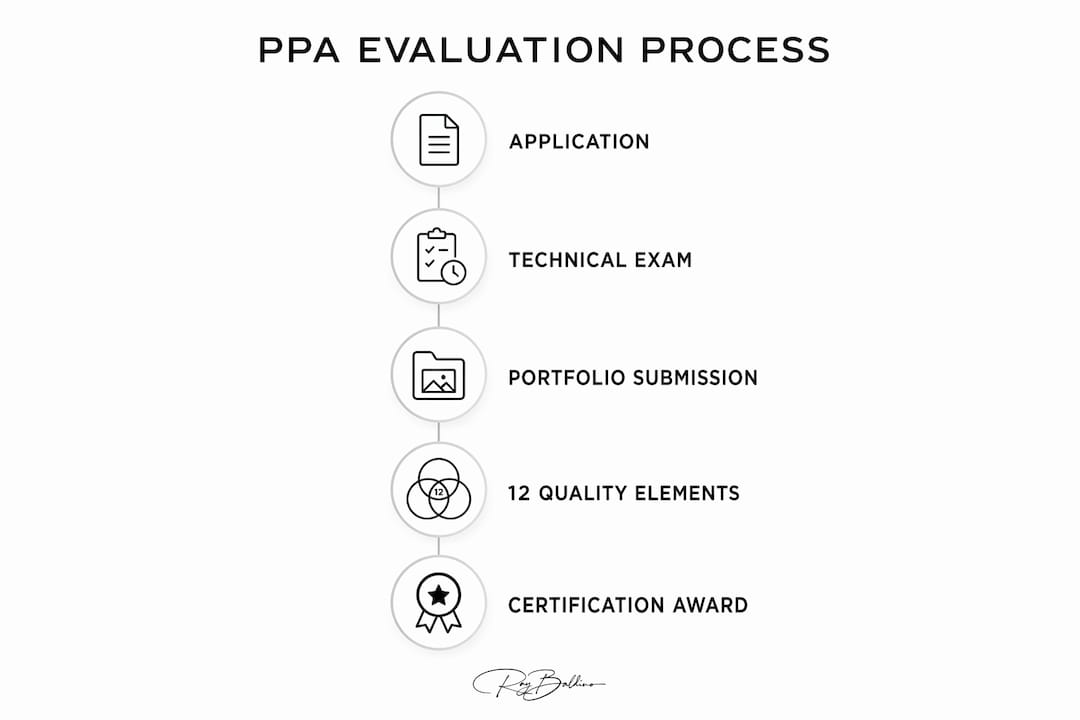
This framework does something important: it removes subjectivity from the evaluation process. Rather than relying on a single judge’s personal taste, every image is measured against the same 12 criteria by a panel of trained evaluators. The result is a trustable, repeatable quality verification that clients and photographers can both reference.
Here is how the 12 elements break down in practice:
- Technical elements: Exposure, color balance, print quality, and technique assess whether the photographer controls the camera and post-processing tools with precision.
- Compositional elements: Composition, center of interest, and subject matter evaluate how effectively the photographer organizes the visual frame.
- Creative and narrative elements: Impact, creativity, storytelling, and presentation measure the image’s ability to communicate and engage.
- Lighting: Assessed separately because it is the single most influential technical variable in any photograph.
The comparison below shows how PPA certification evaluation differs from a standard photography competition:
| Evaluation Type | Criteria Used | Purpose |
|---|---|---|
| PPA CPP certification | 12 standardized elements, peer-reviewed | Verify consistent technical competence |
| Photography competition | Varies by judge and event | Recognize artistic achievement |
| Client portfolio review | Subjective, client-defined | Assess fit for a specific project |
The 12 elements framework allows clients and photographers to interpret PPA-awarded merits as assessed against known quality standards rather than popularity or casual criteria. For a commercial client hiring a photographer for a high-stakes project, that distinction carries real weight.
Why PPA certification is valuable for photographers
Photography has no universal government licensing board. Any person with a camera can legally call themselves a professional photographer. This reality makes voluntary peer-reviewed credentials like the CPP the primary mechanism by which photographers signal credible, measurable expertise to prospective clients. The core value of certification lies in consistent, repeatable competence measurable across core technical fundamentals.
Clients increasingly seek credible verification before committing to a photographer for commercial, editorial, or high-value personal projects. A CPP credential tells a client that the photographer’s technical skills have been tested and confirmed by an independent professional body, not just self-reported on a website. This is a meaningful competitive advantage in a crowded market where every photographer claims to be “experienced” and “professional.”
The CPP also signals something beyond technical skill: it signals discipline. Earning and maintaining the credential requires ongoing education, which means a CPP holder is actively investing in professional development. That commitment to growth is itself a quality signal.
Pro Tip: When presenting your CPP credential to clients, do not just list it as a title. Translate it into outcomes. Tell clients that your certification means they can expect consistent lighting, accurate color, and sharp composition across every image in a shoot, not just the hero shots.
The certification focuses on client verification and continual professional development rather than mere artistic prestige. Photographers who understand this distinction market their CPP far more effectively than those who treat it as a trophy.
How to use PPA certification in your marketing and career growth
Holding a CPP is only valuable if you communicate it correctly. The credential’s power comes from connecting its measured technical standards to specific client outcomes. Here is how to put it to work:
- Reframe the credential in client language. Instead of saying “I am CPP certified,” say “My certification means your project will be delivered with consistent lighting control, accurate color, and technically sound composition on every frame.” Clients care about results, not acronyms.
- Build your portfolio around the 12 elements. Photographers preparing for CPP certification should build portfolios mindful of the 12 elements criteria to simplify evaluation and reduce last-minute adjustments. The same portfolio serves double duty: it satisfies the CPP evaluators and demonstrates your standards to prospective clients.
- Use PPA’s continuing education resources. PPA offers workshops, online courses, and an annual convention called Imaging USA. These resources keep your skills current and provide networking access to thousands of working professionals.
- Leverage the PPA community for referrals. PPA’s member network includes photographers across every specialty. Referrals within this community carry implicit trust because both parties understand the credential standards.
- Display the CPP logo on your website and marketing materials. The logo is a recognized mark within the industry. Clients who have worked with certified photographers before will recognize it immediately.
Proper marketing of PPA certification involves translating technical reliability into client outcomes, emphasizing predictable results in photography projects. Simply listing the credential is the least effective use of it. The most effective use is weaving it into every client conversation as evidence of what they will receive.
For photographers working in specialized fields like automotive photography, the CPP’s emphasis on lighting control and color accuracy is directly relevant to the technical demands of the work. Controlled lighting and precise exposure are not optional in commercial vehicle photography. They are the baseline requirement.
Key takeaways
PPA certification, specifically the CPP designation, is the photography industry’s primary voluntary credential for verifying consistent technical competence in lighting, exposure, color, and composition.
| Point | Details |
|---|---|
| CPP is the core credential | The Certified Professional Photographer designation is what “PPA certified” most commonly means, not mere membership. |
| 12 elements drive evaluation | PPA assesses images against 12 standardized criteria, removing subjectivity from quality verification. |
| No government license exists | The CPP fills the credibility gap in an unregulated industry, acting as a peer-reviewed proof of reliability. |
| Marketing requires translation | Listing the CPP title is less powerful than connecting it to specific client outcomes like consistent lighting and color. |
| Ongoing education is required | Maintaining the CPP demands continuing education credits, signaling active professional development. |
What 35 years taught me about the CPP and what it actually means
I have held PPA credentials for decades, and the single most common misunderstanding I encounter is photographers conflating membership, competition merits, and the CPP into one vague idea of being “PPA certified.” They are not the same thing. Joining PPA as a member does not make you certified. Winning a merit at a print competition does not make you certified. The CPP is a specific credential with specific requirements, and that specificity is precisely what gives it credibility.
What I have found is that the CPP matters most not when you are pitching to other photographers, but when you are sitting across from a commercial client who has been burned by inconsistent work before. That client does not want to hear about your artistic vision. They want to know that the images will be technically correct, on time, and consistent across the entire shoot. The CPP gives you a concrete, third-party verified answer to that concern.
After more than 35 years and over 550 magazine covers, I can tell you that the technical standards the CPP enforces are not arbitrary. Lighting control, color accuracy, and compositional discipline are the foundations of every image that has ever worked in a commercial context. The credential does not teach you to be an artist. It confirms that you have mastered the craft well enough to be trusted with a client’s project.
— Ray
See certified automotive photography in action

Baldinoautomotive brings the standards behind PPA certification to every automotive photography project it undertakes. Ray Baldino holds a Master Photographer credential from the Professional Photographers of America, and that level of technical discipline is visible in every image the studio produces for dealerships, private collectors, and commercial clients. If you want to understand what certified automotive photography looks like in practice, Baldinoautomotive’s portfolio is the clearest demonstration available. For dealerships evaluating photographers, the guide on hiring an automotive photographer explains exactly what credentials and standards to look for before signing a contract.
FAQ
What does CPP stand for in photography?
CPP stands for Certified Professional Photographer, the primary certification credential issued by the Professional Photographers of America. It requires passing a technical exam and submitting portfolio images evaluated against standardized quality criteria.
Is PPA membership the same as PPA certification?
No. PPA membership is open to any photographer who pays dues, while the CPP certification requires passing a written exam and a portfolio review. PPA certified specifically refers to the CPP designation, not membership status.
What are the PPA certification requirements?
The CPP requires passing a technical written exam, submitting portfolio images that demonstrate consistent technical control, and completing continuing education credits to maintain the credential over time.
How does PPA certification help photographers get clients?
Because no government licensing exists for photographers, the CPP serves as a voluntary peer-reviewed credential that verifies technical reliability to prospective clients, giving certified photographers a measurable credibility advantage over uncertified competitors.
What are the PPA 12 elements used for?
The 12 elements, including impact, technical excellence, lighting, composition, and storytelling, form the standardized framework PPA evaluators use to assess images for both CPP certification submissions and merit award competitions.

